What Is a Financial Center?
A Financial Center is a cluster where banking, asset management, insurance, and financial market participants carry out their activities, supported by robust legal and physical infrastructure.
These centers typically include financial intermediaries (banks, agencies, brokerage firms), institutional investors (fund managers, pension funds, insurance companies, hedge funds, venture capital), companies and governments that issue financial instruments, exchanges subject to independent regulation, and clearing and custody institutions. Financial Centers also host M&A activity, IPOs, and corporate service providers. Supporting the ecosystem are valuation and rating agencies, legal and accounting firms, tax consultancies, and corporate formation services.
According to the IMF classification, the largest International Financial Centers (IFCs) are New York, London, and Tokyo. IFCs feature deep, liquid markets that support diverse funding sources and uses, serving both local and global economies. Strong, effective legal and regulatory institutions are a defining characteristic.
Regional Financial Centers (RFCs) — like Shanghai, Shenzhen, Frankfurt, and Sydney — are smaller in scale and serve their respective regions, playing important roles in facilitating foreign investor access.
Offshore Financial Centers (OFCs) specialize in specific financial services and serve smaller-scale economies, with relatively lighter regulatory frameworks. Key OFCs include Ireland, the Caribbean, Hong Kong, Singapore, and Luxembourg.
What Does It Take to Become a Financial Center?
- Strategic location and proximity to trade and capital markets
- Globally recognized financial institutions and deep capital markets with independent regulatory bodies
- World-class communication, logistics, and trade infrastructure
- Independent courts that follow transparent, predictable laws — free from daily political influence
- Simple, predictable tax legislation with competitive rates
- Well-educated, high-quality human capital
- A safe, democratic, open society offering a high standard of living, quality education, and respect for diverse lifestyles — guaranteed by universally accepted laws
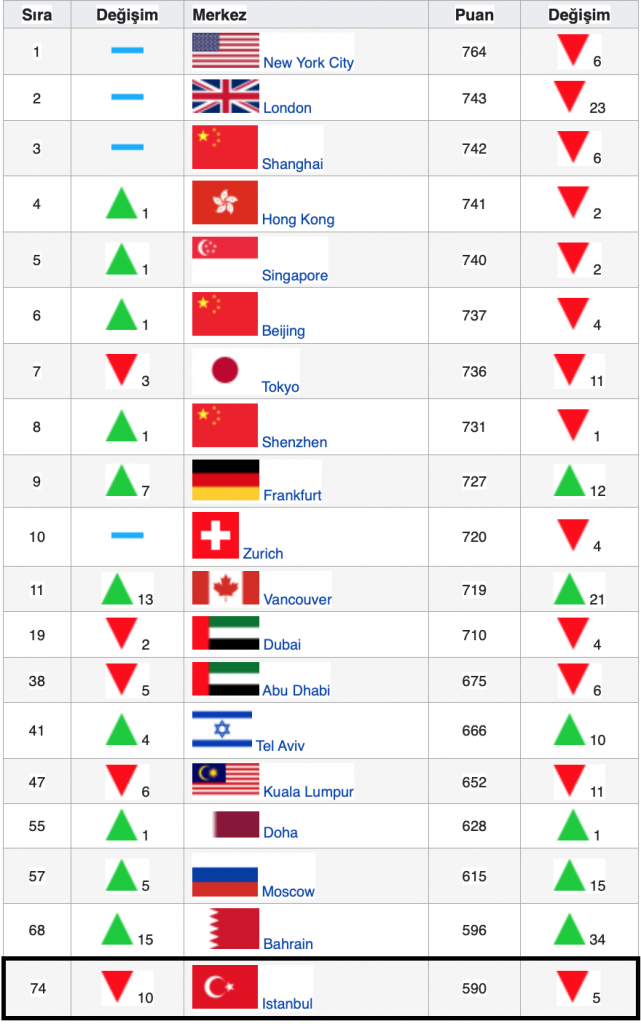
As of March 2021, the global financial center rankings show that traditionally dominant cities are facing serious competition from emerging centers including Toronto, Seoul, Boston, Geneva, San Francisco, Sydney, Luxembourg, and Dubai.
Istanbul — sitting at the crossroads of the world’s oldest trade routes with a strategic geographic position — ranks only 74th, behind many economies far smaller than its own.
The Istanbul Finance Center (İFM) project was planned in 2009 on approximately 2.7 million square meters in Ataşehir, Istanbul, with a targeted completion date of 2022. The plan was to relocate the Central Bank of Turkey, state-owned banks, and other financial institutions to this center. But as it stands, the İFM is little more than a commercial construction project. Moving the Central Bank from Ankara to Istanbul isn’t fundamentally different from relocating Atatürk Airport to the newly built one at a cost of billions. Simply moving public financial institutions into new buildings won’t make Istanbul a financial center.
In 2021, Istanbul dropped 10 places to 74th in the global rankings. Despite being a historic commercial hub with strategic location and a trained workforce, Istanbul falls far short of meeting the requirements for financial center status. Here’s why:
- Infrastructure: Speed and efficiency are non-negotiable for financial centers. Turkey’s internet connection speed ranks 103rd out of 175 countries worldwide. In a financial world where milliseconds matter, becoming a regional financial center with this infrastructure simply isn’t possible.
- Independent Institutions: Turkey’s financial regulatory bodies — starting with the Central Bank — face serious questions about independence and transparency. Institutions managed by politically appointed, merit-challenged leadership can’t credibly claim independence — and investors won’t overlook that.
- Lifestyle and Universal Values: Financial centers need to attract top talent from around the world. That requires offering a high standard of living, quality education, and genuine respect for personal freedoms. Recent trends in Turkey — rights violations, interference with lifestyles, and pressure on freedom of thought — make it difficult to attract and retain the caliber of professionals that financial centers demand.
- Tax System: Turkey’s current tax system relies heavily on indirect taxes, is far from simple, and carries rates considerably higher than regional competitors. A country aspiring to be a financial center needs to offer compelling tax incentives. Unpredictable enforcement and politically influenced audits remain among investors’ biggest concerns.
- Macroeconomic Situation: Turkey’s CDS (risk premium) trades above 370 basis points — just behind Venezuela and Argentina among the world’s riskiest countries. Structural current account deficits, budget deficits, inadequate central bank reserves, high external debt, off-balance-sheet foreign currency obligations from public-private partnerships, and high lira volatility all contribute. Turkey’s credit rating sits well below investment grade, in speculative/high-risk territory. Under these conditions, recognition as a financial center simply isn’t realistic.
The bottom line: building tall towers and relocating politically controlled, underperforming state banks doesn’t create a financial center. Real financial center status requires structural reforms across every dimension of society — starting with infrastructure and creating an environment that earns domestic and international investor confidence. What’s striking is that many of the reforms needed aren’t even directly financial. Rule of law, judicial independence, constitutional guarantees of freedom, and political transparency — these come first.